
WHAT YOU WILL MAKE
Make four Minecraft block data cards
The warehouse manager will not pour the potion into the grid containing the torch. Java's types do similar checks: integers, decimals, true and false, and literals have their own rules. In this lesson, we'll meet six common types, see why dividing 5 by 2 might result in 2, and create a set of information cards with clear fields for the four types of blocks.
Before you start: It is recommended to complete Lessons 1–2 first

01 / 12
Type is an agreement
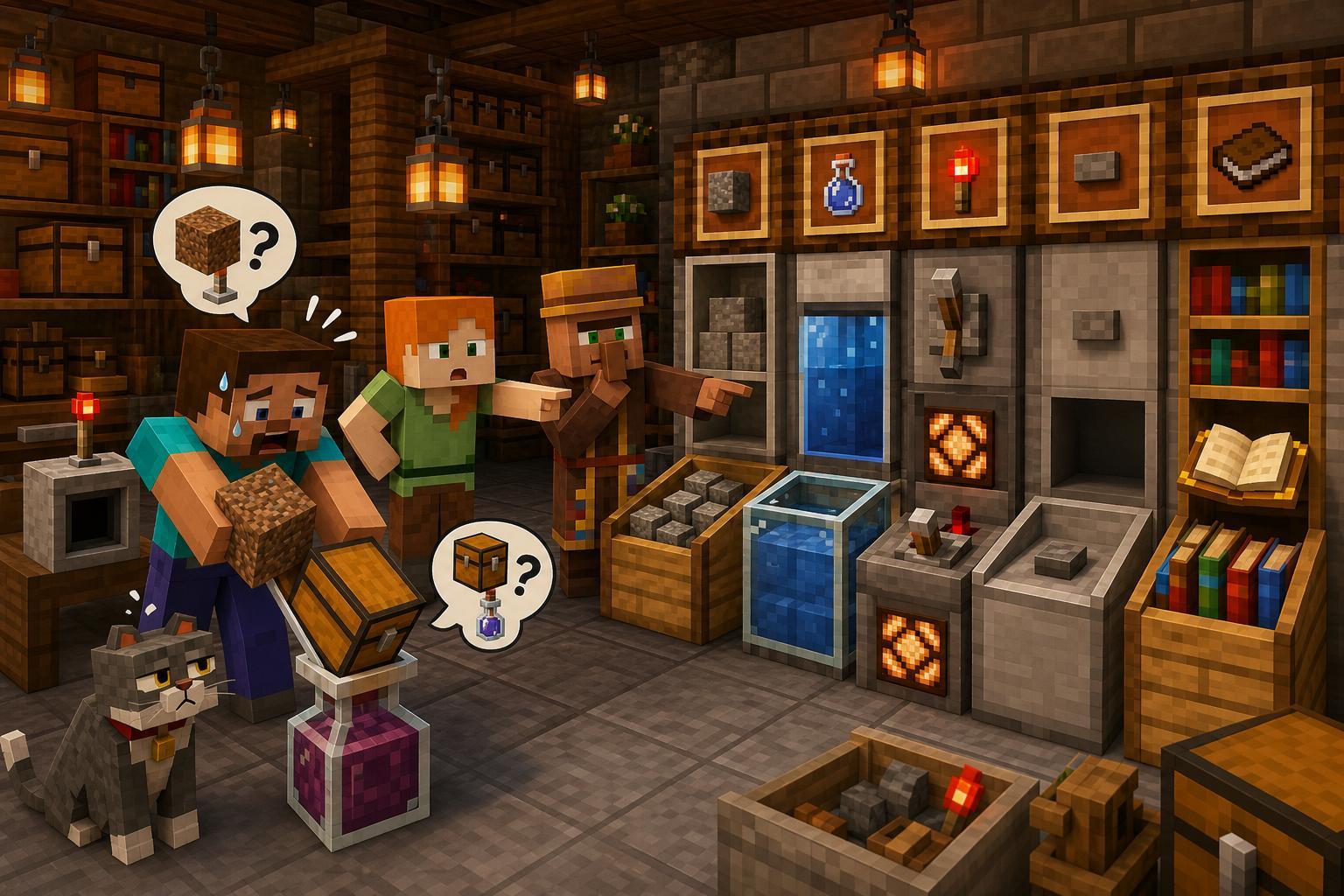
"Health value 20" and "player name Alex" both appear to be displayed on the screen, but they are not the same data. Numbers can be involved in calculations, and text can be searched and intercepted. Types let the compiler know what you are going to save and how you are going to use it.
- Full quantity: usually starts with int.
- Decimals possible: double is used in this lesson.
- True or false status: use boolean.
- Name or message: Use String.
02 / 12
Six commonly used types, one data card
| Type | Purpose of this lesson | Example |
|---|---|---|
| int | Ordinary integer | 64 |
| long | A larger range of integers | 9_000_000_000L |
| double | Numerical values with decimals | 1.5 |
| boolean | True and false status | false |
| char | A UTF-16 unit | 'A' |
| String | A paragraph of text | "Stone" |
Complete program · BlockData.java
public class BlockData {
    public static void main(String[] args) {
        int maxStack = 64;
        long worldBlocks = 9_000_000_000L;
        double hardness = 1.5;
        boolean falls = false;
        char grade = 'A';
        String blockName = "Stone";
        System.out.println(blockName + ": " + hardness);
        System.out.println(maxStack + " / " + worldBlocks);
        System.out.println(falls + " / " + grade);
    }
}
Output
Stone: 1.5
64 / 9000000000
false / A03 / 12
int and long: integers also have boundaries
| Type | Representable integer range |
|---|---|
| int | -2,147,483,648 to 2,147,483,647 |
| long | -9,223,372,036,854,775,808 To 9,223,372,036,854,775,807 |
Snippet: place inside main and run separately
int stack = 64, height = 320, score = -15;
System.out.println(stack + height + score);
long exploredBlocks = 9_000_000_000L;
System.out.println(exploredBlocks);
int oneMillion = 1_000_000;
System.out.println(oneMillion);
Output
369
9000000000
1000000
Underlines in numbers only aid human reading and do not enter the output. A capital L at the end of a large integer indicates a long literal. 9_000_000_000 exceeds the range of int literals. You cannot understand it as int first and then expect the long on the left to automatically save the situation.
04 / 12
double: decimals are useful and approximate
- intNumber of items
For example 4 - doubleExercise coordinates or hardness
For example 1.5 - floatAnother floating point type
The literal can be written as 0.8F
Snippet: place inside main and run separately
double hardness = 1.5;
double spawnX = -23.75;
float lightRatio = 0.8F;
System.out.println(hardness);
System.out.println(spawnX);
System.out.println(lightRatio);
System.out.println(0.1 + 0.2);
Output
1.5
-23.75
0.8
0.30000000000000004
The last line is not a computer casually typing a few more words. Many decimal fractions cannot be represented exactly in binary floating point numbers, and operations will leave approximation errors. Coordinate experiments can usually accept this small error, but accurate pricing requires the selection of another tool.
05 / 12
boolean: only true and false
| Expression | Result | Annotations |
|---|---|---|
| 12 >= 8 | true | There are at least 8 |
| 12 == 0 | false | Not 0 |
| !false | true | Flip the true from the false |
| !true | false | Flip again |
Snippet: place inside main and run separately
int torches = 12;
boolean enoughLight = torches >= 8;
boolean empty = torches == 0;
boolean gateOpen = false;
gateOpen = !gateOpen;
System.out.println(enoughLight);
System.out.println(empty);
System.out.println(gateOpen);
Output
true
false
true
boolean expresses the answer to a question. It does not accept yes, True, or the number 1 as true or false literals. The comparison operation returns a boolean; it does not itself choose the next action for the program.
06 / 12
char and String: Are the quotation marks correct?
| Writing method | Type | Meaning |
|---|---|---|
| 'A' | char | A UTF-16 unit |
| '钻' | char | The Chinese character used in this example |
| "Alex" | String | A string of text |
| "A" | String | A string of length 1 |
Snippet: place inside main and run separately
char grade = 'A';
char symbol = '钻';
String playerName = "Alex";
System.out.println(grade + " / " + symbol);
System.out.println(playerName);
Output
A / 钻
Alex07 / 12
Integer division: Where does the decimal part go?
| Expression | Result | Calculate what happened |
|---|---|---|
| 5 / 2 | 2 | Division of two integers |
| 5.0 / 2 | 2.5 | One side is already double |
| (double) (5 / 2) | 2.0 | Calculate 2 first, then convert |
| (double) 5 / 2 | 2.5 | Convert first, then divide |
Snippet: place inside main and run separately
System.out.println(5 / 2);
System.out.println(5.0 / 2);
System.out.println((double) (5 / 2));
System.out.println((double) 5 / 2);
System.out.println(-5 / 2);
Output
2
2.5
2.0
2.5
-2
Integer division truncates the decimal part toward zero: 5 / 2 is 2, -5 / 2 is -2. Don't write it off simply as "always round down." When decimals are required, let at least one side be a float before division occurs.
08 / 12
Type conversion: first ask whether information will be lost

| Start | Conversion | End point |
|---|---|---|
| int 12 | assigned to double | 12.0 |
| double 12.8 | (int) forced conversion | 12 |
| double -12.8 | (int) forced conversion | -12 |
Snippet: place inside main and run separately
int level = 12;
double displayLevel = level;
double exactXp = 12.8;
int shownXp = (int) exactXp;
System.out.println(displayLevel);
System.out.println(shownXp);
System.out.println((int) -12.8);
Output
12.0
12
-1209 / 12
Type debugging: the left and right sides must be compatible

Intentional typo: check four lines separately
int hardness = 1.5;
char grade = "A";
String name = 'Steve';
long blocks = 9_000_000_000;- Decimal 1.5 should be caught by double.
- This example value of char is written as 'A', using single quotes.
- The name is a string of text, and it should be written "Steve".
- Add a capital L at the end of the large integer literal.
Snippet: place inside main and run separately
String countText = "64";
int count = 64;
System.out.println(countText + 1);
System.out.println(count + 1);
Output
641
6510 / 12
Design four block data cards
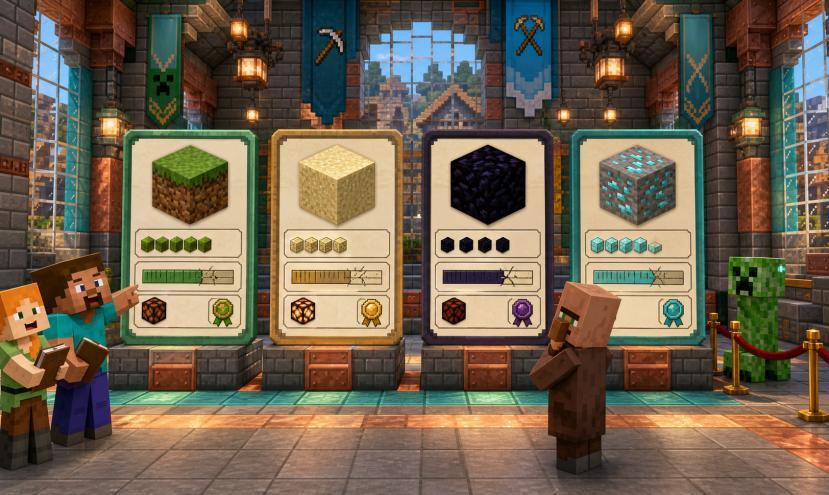
| Block | Upper limit of each group | Practice Hardness | Gravity drop | Rating |
|---|---|---|---|---|
| Grass Block | 64 | 0.6 | false | C |
| sand | 64 | 0.5 | true | B |
| Obsidian | 64 | 50.0 | false | S |
| Diamond Ore | 64 | 3.0 | false | A |
Each card contains five items: name, maximum number of each group, hardness, whether it fell due to gravity and rating. The reference program below arranges them in a row, with four rows corresponding to four cards. The numerical values are used in the exercise sheet on this page; the rating is our custom label for the work.
11 / 12
complete work: four cards are output one by one
Complete program · FourCards.java
public class FourCards {
    public static void main(String[] args) {
        String name = "Grass Block";
        int maxStack = 64;
        double hardness = 0.6;
        boolean falls = false;
        char grade = 'C';
        System.out.println(name + " | " + maxStack + " | "
            + hardness + " | " + falls + " | " + grade);
        name = "sand";
        hardness = 0.5;
        falls = true;
        grade = 'B';
        System.out.println(name + " | " + maxStack + " | "
            + hardness + " | " + falls + " | " + grade);
        name = "Obsidian";
        hardness = 50.0;
        falls = false;
        grade = 'S';
        System.out.println(name + " | " + maxStack + " | "
            + hardness + " | " + falls + " | " + grade);
        name = "Diamond Ore";
        hardness = 3.0;
        falls = false;
        grade = 'A';
        System.out.println(name + " | " + maxStack + " | "
            + hardness + " | " + falls + " | " + grade);
    }
}
Output
Grass Block | 64 | 0.6 | false | C
sand | 64 | 0.5 | true | B
Obsidian | 64 | 50.0 | false | S
Diamond Ore | 64 | 3.0 | false | A12 / 12
Find reasons for your type selection

- DistinguishNumeric value or text
- OptionsInteger or decimal
- CheckQuotes and suffixes
- ConversionCheck information loss
- ExplanationPrediction and re-verification
- Basics: Save a pet's name, life, number of items, adult status and rating.
- Advanced: Compare 9 / 4, 9.0 / 4, (double) 9 / 4; the result is 2, 2.25, 2.25.
- Creation: Design a data card for the mysterious square, and add a boolean field for whether it emits light.
Technical reference: Java SE 11 Language Specification, Chapter 4 Data Types, Chapter 5 Type Conversion. Official documentation: docs.oracle.com/javase/specs/jls/se11/html/.
TAKE IT WITH YOU
Take the lesson offline
The complete lesson, code, diagrams and exercises, in your preferred language.